
New Collaborative Care Standard of Practice Now in Effect
The updated Standard of Practice on Collaborative Care became effective June 1.
This standard is the culmination of over two years of development and is substantially different than the previous iteration. Council approved the revised three-part standard on March 18.
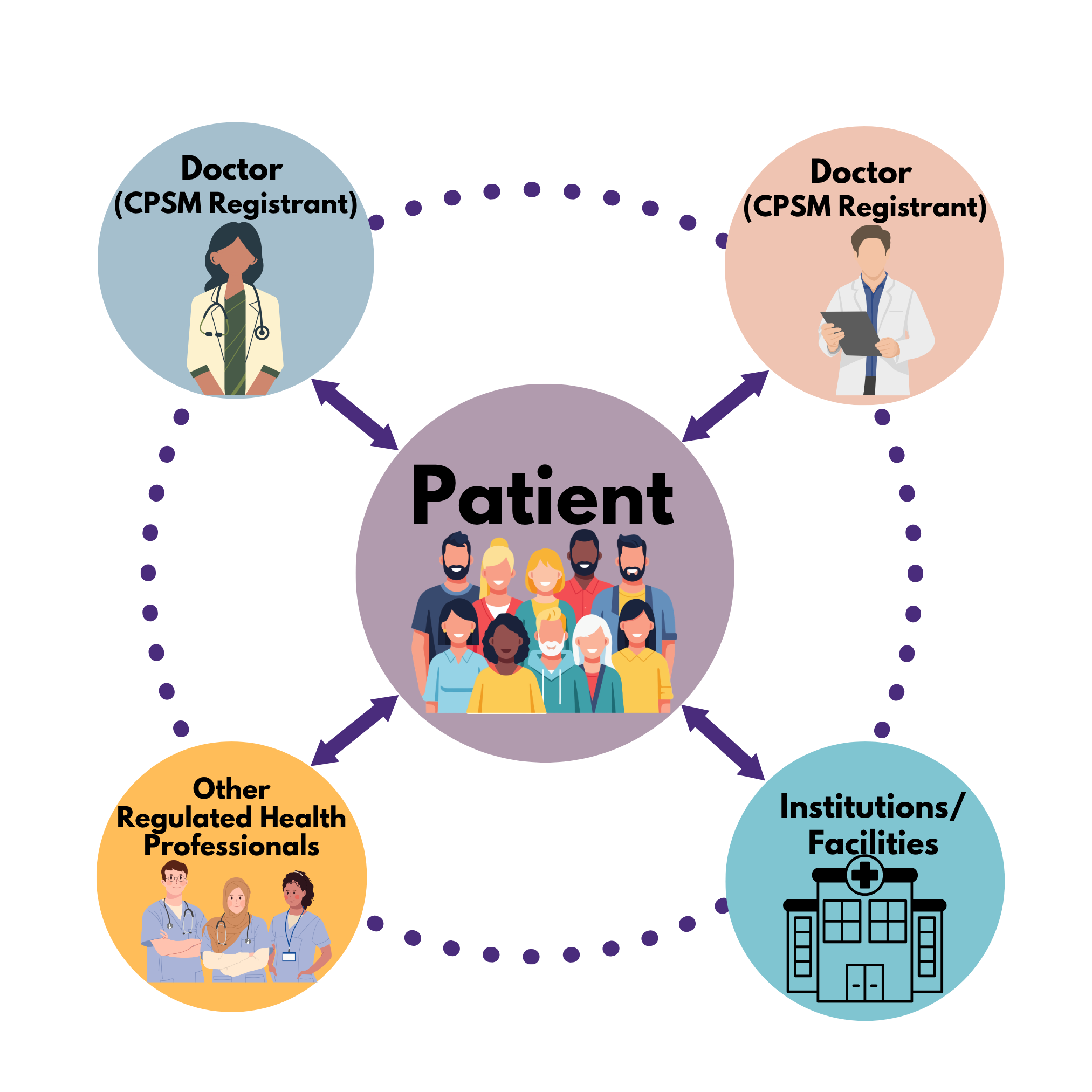
The standard encourages registrants to reflect on their collaborative practices; for some, this may include evolving how they interact with other registrants and healthcare professionals to strengthen communication and teamwork in the interest of the patient.
WHAT HAS CHANGED?
The Standards are concise and focus on behaviours. The principles for the standards are built on the Code of Ethics and Professionalism and were developed with one goal in mind: improving patient care.
The updates include:
- an expanded focus between members of the medical profession through non-urgent and urgent consultations
- clarifying roles
- introducing the concept of closed-loop communication, and
- timelines for turnaround communications
This Standard is not intended to place blame on the system or individuals; it is about accountability and shared responsibility.
There are now three separate standards. Each standard is supported with its own Contextual information document, which includes frequently asked questions, to assist with applying the standards in practice.
Standard |
Contextual Information |
| Collaborative Care | |
|
Contextual Information - Emergent, Urgent, and Inpatient Requests |
|
| Non-Emergent Consultation Requests |
HOW WAS THE STANDARD DEVELOPED?
A working group made up of specialists, family physicians, and representatives of the public, was created and tasked with updating the Standard.
Once drafted, the standard was developed through extensive consultation with physicians, system leaders, and partners during pre-consultations throughout 2025.
In October 2025, we partnered with Doctors Manitoba and Shared Health to introduce the principles of the Standards at the Referral and Consultation Summit, which over 100 physicians attended who provided important feedback that led to some adjustments.
A public consultation was held in early 2026; feedback was received from the general public, registrants, and other partners.
BACKGROUND
In 2022, CPSM surveyed registrants on the existing Standard of Practice – Collaborative Care after becoming aware of serious concerns affecting the delivery of medical care.
Our first step was understanding the barriers to collaborative care —many of which stem from staffing shortages, administrative burden, burnout, and limited resources beyond registrants’ control— which allowed us to develop this Standard to focus on the one thing the profession can influence as individuals: our behaviours toward one another.
Supporting data from our Standards and Quality Assurance and Complaints & Investigations departments indicated serious issues with how medical care is delivered, particularly in the communication and acceptance of doctor-to-doctor consultations.
A working group made up of specialists, family physicians, and members of the public, was created and tasked with updating the Standard.
IMPLEMENTATION
We recognize successful implementation of a standard such as this, which aims to influence human behaviour, will not occur overnight but will be reflected in incremental changes over time.
Resources
Contextual guidance has been developed to address the questions and concerns we heard during the consultation process. Each standard has its own contextual information.
During the consultation, we heard from physicians who are already meeting the standard, particularly regarding timelines. Following a phasing-in period, additional resources highlighting best practices from physicians who are setting the benchmark will be shared.
Share your best practices
If you have an effective way of managing referrals or have found an efficient system for sending closing the loop communications, we want to hear from you. Please send us an email at: communications@cpsm.mb.ca.
Addressing accountability
Those who require help to meet the standard will be supported through our quality-improvement initiatives. The Quality team may initiate a conversation to better understand the circumstances and determine whether support or resources may be helpful.
If you need support, we encourage you to contact the Quality Assurance program at qualityassurance@cpsm.mb.ca.